The traditional anomaly detection scenario involves detecting unusual
behavior in a vast sea of normal data. To empirically test your anomaly-
detection IoT application requires you to setup a large environment of
sensors sending data to your Google Pubsub application.
To do this in real-time to verify response time constraints is specially hard
to do.
To demonstrate how simulation can simplify this task, we improved on the
Google Cloud IoT Core End-to-end example tutorial by making 10 lines of
code change to their pubsub Python server code.
The changes merely count the number of devices detected (by their
serial number), and the anomaly is detected if any temperature value
exceeds the threshold, printing a WARN message.
When we start 10 simulated sensors in MIMIC MQTT Simulator configured
to connect to Google IoT Core, they are detected by the listening Pubsub
application. We can then change in real-time the temperature of one of them,
causing the pubsub application to detect the exceeded threshold.
This 1-minute Youtube video shows the entire demo in real-time.
We then used their Python manager client to define 90 more devices for
a total of 100. Then we ran the same scenario again. Notice the lag between
when the event occurred and the detection by the Pubsub application.
Here we show the entire demo in this 1-minute Youtube video.
Monday, October 14, 2019
Wednesday, August 28, 2019
Guard your IoT Application against hackers using IoT Simulation
The Internet of Things opens up many vectors for security vulnerabilities
as detailed in RFC 8576.
Vulnerabilities in all stages of a IoT device's life cycle include malware baked in
during manufacturing, or patched while operating by exploiting zero-day
vulnerabilities, specially after the manufacturer's support of the old device is
discontinued (end-of-life). This malware usually causes the IoT device to
deviate from its intended function for some nefarious purpose.
Part of any IoT Testing and Proof of Concept (PoC) includes addressing security
concerns by adding security monitoring solutions to prevent intrusions,
malware, etc in order to prevent the high failure rates of IoT projects.
While preventing malware through authentication, authorization and privacy is
a first defense, the IoT monitoring solution should detect behavior that is not
"normal". A usual test scenario then consists in reproducing cases of IoT devices
that deviate from their expected behavior. Unless you have a lab full of hacked
devices, this is not easy to do.
An IoT Simulator such as MIMIC IoT Simulator is designed to easily recreate
scenarios meant to test your IoT monitoring solution for common hacking
scenarios, such as misbehaving IoT devices (eg. hacked devices sending unusual
Internet traffic, or accessing unauthorized resources), incorrectly configured
firewall or load-balancing rules, reported common vulnerabilities and exposures
(CVE) such as in this article .
The "normal" behavior of an IoT device can be characterized by the network
traffic it emits and the resources it accesses. Monitoring solutions can learn
this behavior and alert if it deviates from this pattern. MIMIC can control any
simulated device to behave differently at any point in time, and can easily create
different behaviors on demand. Thus, the monitoring solution can be exercised
to prove that it handles certain scenarios, such as higher traffic rates, network
traffic to different destinations and access to restricted resources. Since the
simulator creates reproducible scenarios, it can be part of regression tests
supporting an agile development cycle.
For example, this Youtube video demonstrates complete, dynamic, real-time
control of message generation rates in MIMIC.
as detailed in RFC 8576.
Vulnerabilities in all stages of a IoT device's life cycle include malware baked in
during manufacturing, or patched while operating by exploiting zero-day
vulnerabilities, specially after the manufacturer's support of the old device is
discontinued (end-of-life). This malware usually causes the IoT device to
deviate from its intended function for some nefarious purpose.
Part of any IoT Testing and Proof of Concept (PoC) includes addressing security
concerns by adding security monitoring solutions to prevent intrusions,
malware, etc in order to prevent the high failure rates of IoT projects.
While preventing malware through authentication, authorization and privacy is
a first defense, the IoT monitoring solution should detect behavior that is not
"normal". A usual test scenario then consists in reproducing cases of IoT devices
that deviate from their expected behavior. Unless you have a lab full of hacked
devices, this is not easy to do.
An IoT Simulator such as MIMIC IoT Simulator is designed to easily recreate
scenarios meant to test your IoT monitoring solution for common hacking
scenarios, such as misbehaving IoT devices (eg. hacked devices sending unusual
Internet traffic, or accessing unauthorized resources), incorrectly configured
firewall or load-balancing rules, reported common vulnerabilities and exposures
(CVE) such as in this article .
The "normal" behavior of an IoT device can be characterized by the network
traffic it emits and the resources it accesses. Monitoring solutions can learn
this behavior and alert if it deviates from this pattern. MIMIC can control any
simulated device to behave differently at any point in time, and can easily create
different behaviors on demand. Thus, the monitoring solution can be exercised
to prove that it handles certain scenarios, such as higher traffic rates, network
traffic to different destinations and access to restricted resources. Since the
simulator creates reproducible scenarios, it can be part of regression tests
supporting an agile development cycle.
For example, this Youtube video demonstrates complete, dynamic, real-time
control of message generation rates in MIMIC.
Monday, June 17, 2019
MIMIC SNMP SImulator and Prometheus FOSS
We installed the Prometheus free open-source software NMS, and enabled
SNMP monitoring following this post.
Once we pointed Prometheus at a out-of-the-box 25-node simulated network with
MIMIC SNMP Simulator
we can monitor network interfaces. The graphing can be
compared to a commercial offering as shown below:
SNMP monitoring following this post.
Once we pointed Prometheus at a out-of-the-box 25-node simulated network with
MIMIC SNMP Simulator
we can monitor network interfaces. The graphing can be
compared to a commercial offering as shown below:
Friday, June 14, 2019
IoT Control System at the edge: MIMIC MQTT Simulator and AWS IoT Greengrass
Overview
AWS IoT Greengrass is Amazon's IoT edge processing platform. We used theirdocumentation and other sources [1] with MIMIC MQTT Simulator to setup a
simple control system at the edge to test bi-directional MQTT message flow
(from sensors to control logic, and from control logic to actuator).
For those who'd rather skip to the video, here is the 2-minute Youtube video.
This example illustrates the purpose of IoT at the edge: the processing that does
not need the cloud should happen locally. In this test, everything is occurring at
the edge, we just added device shadow synchronization to the AWS IoT cloud
for illustration.
Details
You need to setup an account at Amazon AWS IoT. Once logged into the AWS IoTconsole, and a Greengrass Group has been created according to their
Getting Started manual. We setup a group called GG_group2 with a core
GG_group2_Core.
Then we simulated our usual bi-directional simple control system at the edge,
with these devices
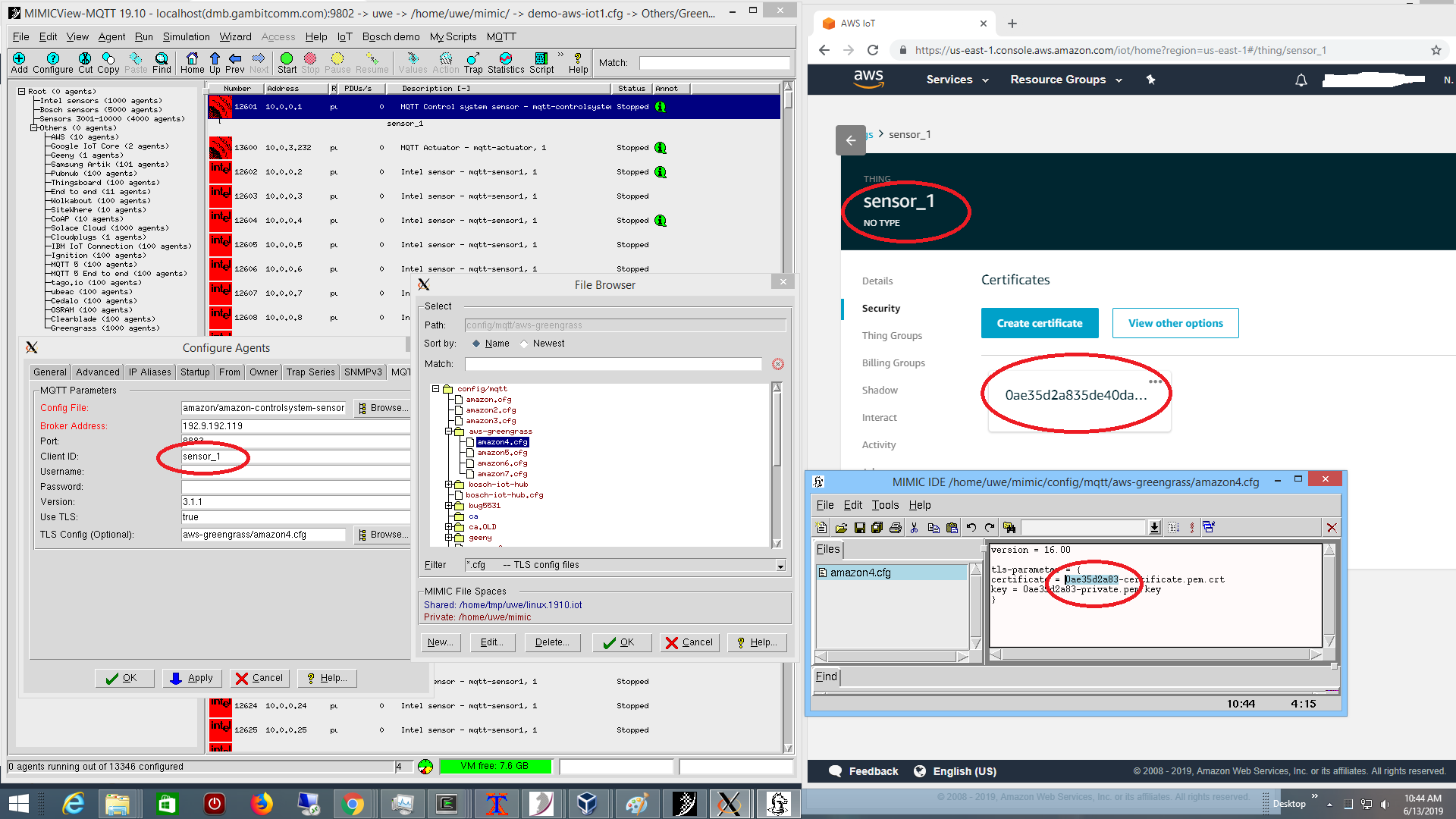
including a sensor sensor_1 reporting telemetry to Greengrass core,
running in MIMIC as seen above on the left, with certificates as configured in
AWS on the right.
When the actuator (eg. cooling system) in the control system is off, the sensor
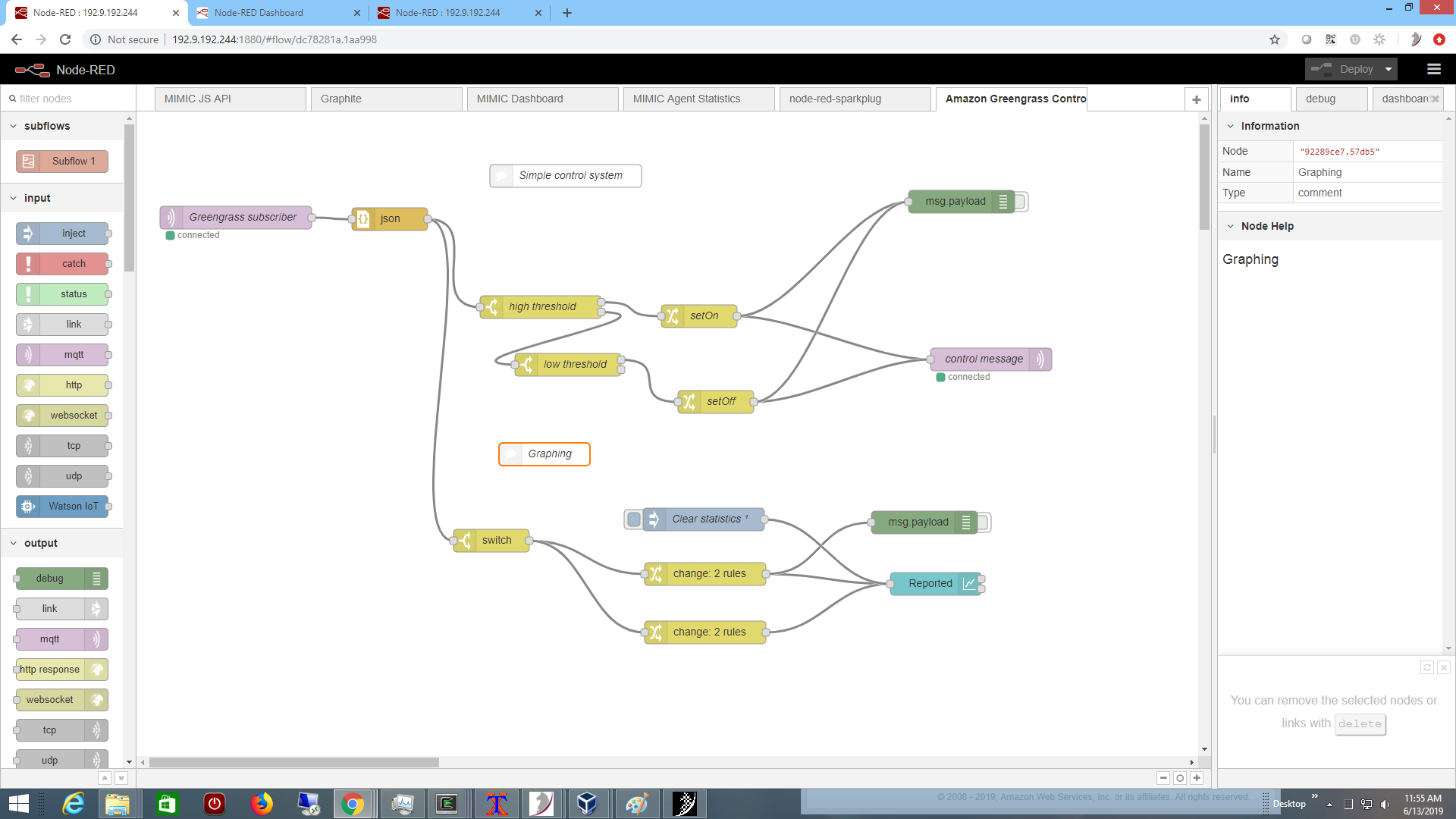
temperature heats, and when it is on, then it cools. We implemented the control
system logic in a Node-RED flow, rather than in a Lambda function.
It turns the actuator on if the temperature exceeds a high threshold, and turns it
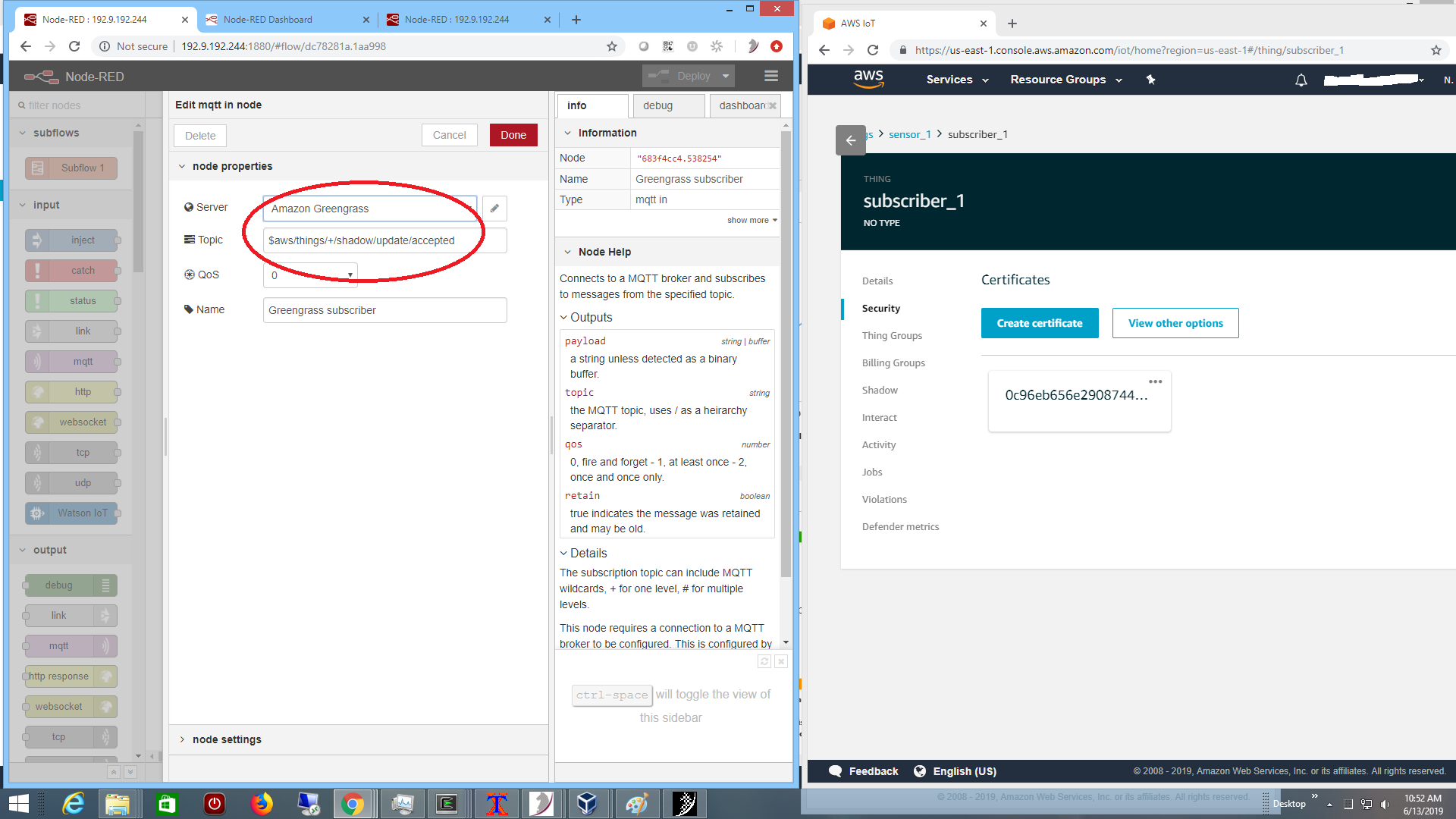
off if the temperature is cool enough. The connectivity to the core broker is setup
as a subscriber to the shadow updates as shown below on the right:
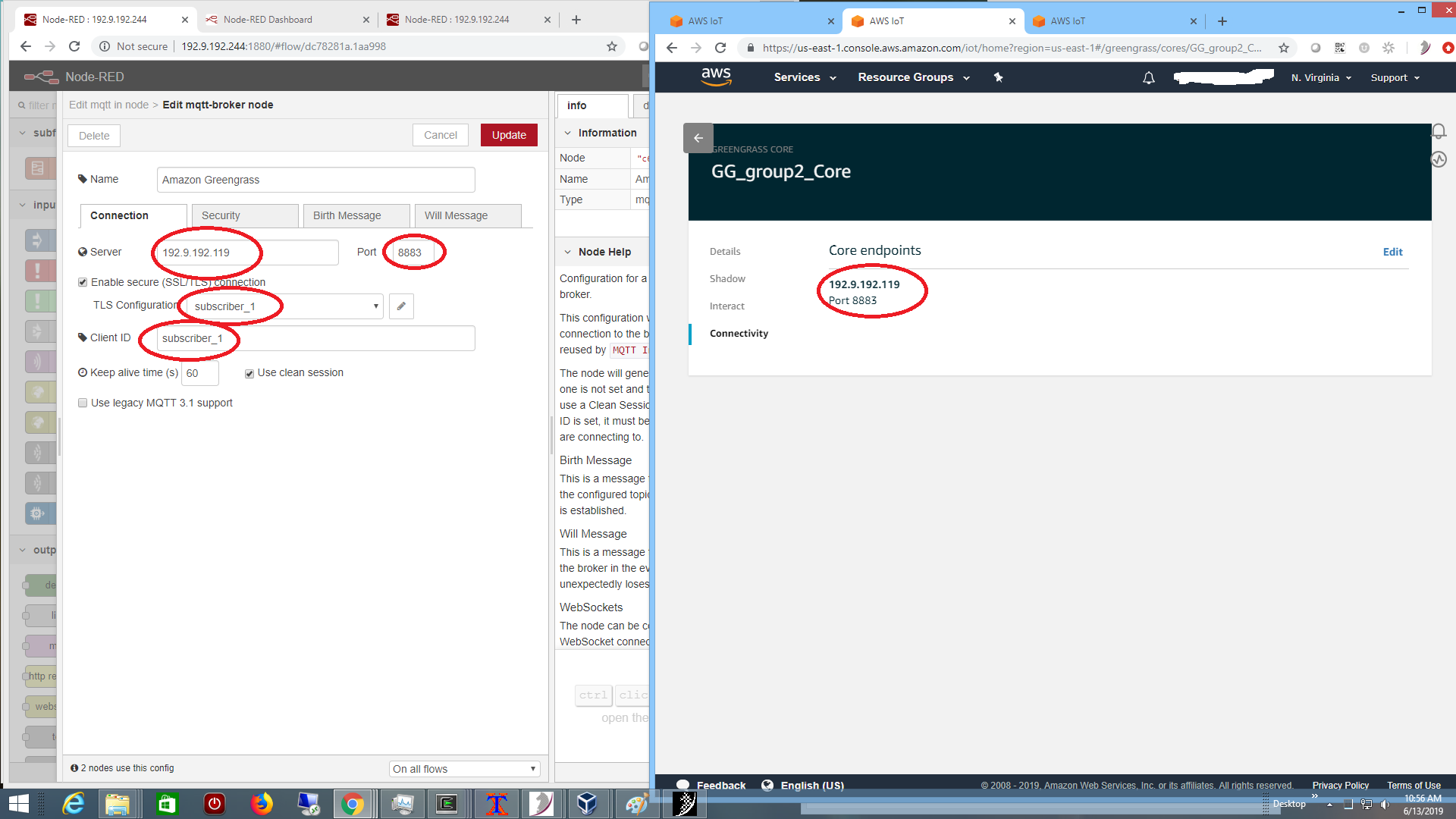
and the Node-RED subscriber is configured to connect to the broker at the edge:
with TLS certificates exported by AWS:
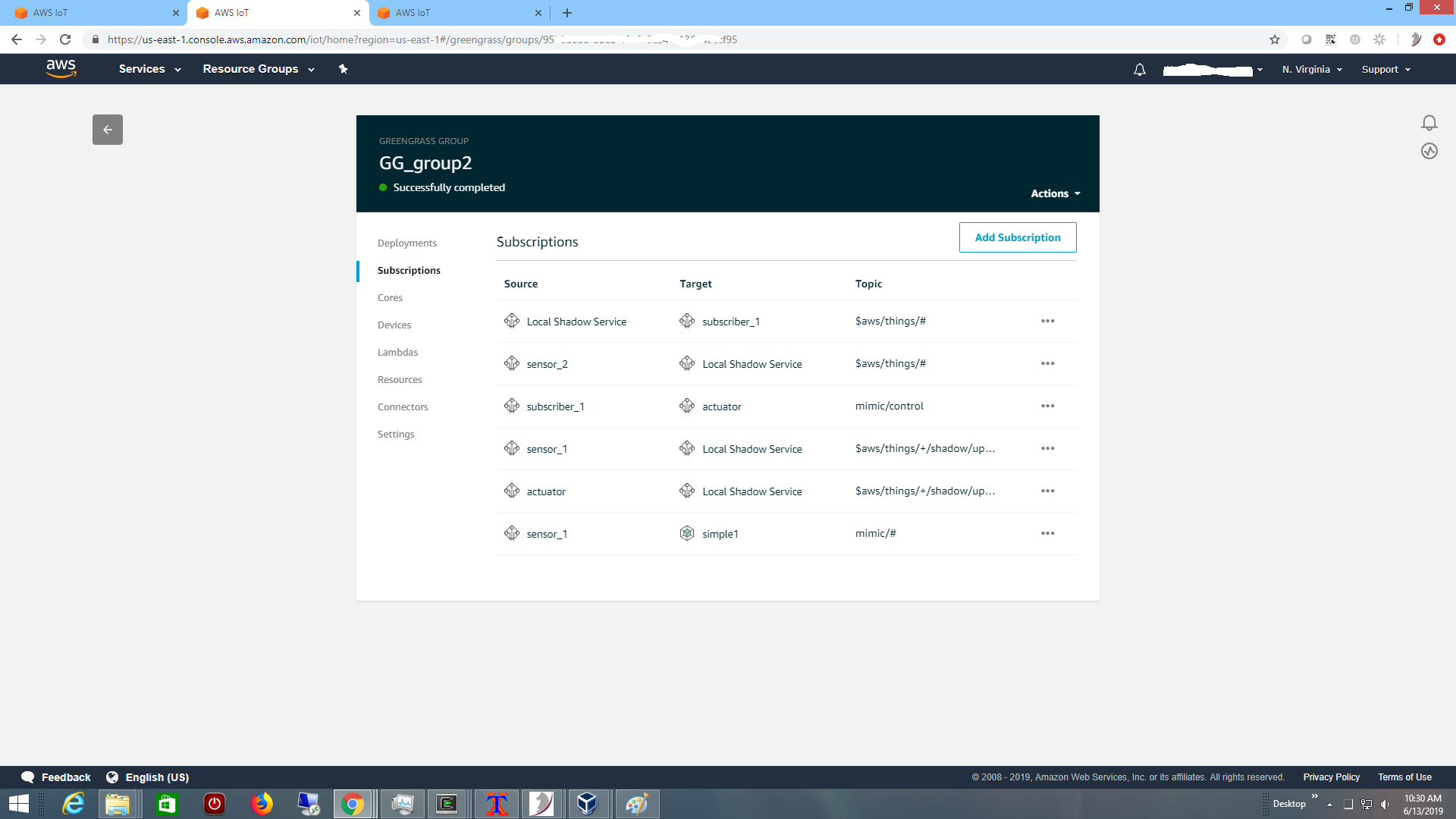
The parts of the system need permission to publish as defined in the Greengrass
subscriptions:
Once everything is setup, the control system reaches a normal steady state at the
edge, as visualized by the Node-RED graphing rules, as shown in this 2-minute
Youtube video.
Conclusion
We saw that by using MIMIC MQTT Simulator we can create a real-timescalable, predictable, customized IoT Edge Control System scenario that
compresses the state transitions into a period short enough for showing in
less than 3 minutes.
Future work can improve on this to make it more scalable, test exceptions
(eg. what if the sensor does not cool down when fan is on?), test different
implementations (eg. Lambda function vs. Node-RED), etc.
References:
[1] The Hitchhikers Guide to AWS IoT
Monday, June 3, 2019
MIMIC MQTT Simulator driving a IoT demo at Cisco Live
If you are planning to attend Cisco Live next week, take a look at a
dynamic IoT platform demo. You will see a cruise ship with dynamic,
real-time cabin temperature and door lock sensors simulated by
MIMIC MQTT Simulator.
Here you see a drill-down to a particular sensor:
Update 6/12/2019: Here is a tweet to a video at the show.
dynamic IoT platform demo. You will see a cruise ship with dynamic,
real-time cabin temperature and door lock sensors simulated by
MIMIC MQTT Simulator.
Here you see a drill-down to a particular sensor:
Update 6/12/2019: Here is a tweet to a video at the show.
Friday, May 24, 2019
MIMIC MQTT Simulator: dynamic, scalable device shadows on AWS IoT
This 2-minute Youtube video shows multiple, independent device shadows
updating from MIMIC MQTT Simulator to Amazon AWS IoT with dynamic,
real-time, predictable, scalable values.
MIMIC allows to quickly create on-demand prototypes and proof-of-concepts for
your particular IoT Application based on AWS IoT device shadows.
Update 12/04/2019:
Our AWS IoT Get Started Tutorial Lab allows you to get started with
AWS IoT Core in a matter or minutes, learning and experimenting quickly.
Update 2/24/2020:
Here is a video testing AWS IoT Rules.
updating from MIMIC MQTT Simulator to Amazon AWS IoT with dynamic,
real-time, predictable, scalable values.
MIMIC allows to quickly create on-demand prototypes and proof-of-concepts for
your particular IoT Application based on AWS IoT device shadows.
Our AWS IoT Get Started Tutorial Lab allows you to get started with
AWS IoT Core in a matter or minutes, learning and experimenting quickly.
Update 2/24/2020:
Here is a video testing AWS IoT Rules.
Monday, May 13, 2019
MIMIC Simulator integrated with Telegraf OSS monitoring application
What better way to quickly develop / test / prototype Telegraf deployments
than with simulated data? MIMIC Simulator delivers the dynamic,
customizable, scalable data for the variety of Telegraf input plugins.
To exercise SNMP interoperability, for this experiment we graph real-time
interface statistics from a simulated Cisco ASR 9000 router.
The graph in Grafana shows ifInOctets SNMP data collected from the MIMIC
simulated Cisco ASR 9000. The data is collected by the Telegraf application
using the SNMP plugin, and output to InfluxDB. Grafana is showing the data
using the InfluxDB as data source.
The Telegraf, InfluxDB and Grafana setup was done using this link:
https://lkhill.com/telegraf-influx-grafana-network-stats/
than with simulated data? MIMIC Simulator delivers the dynamic,
customizable, scalable data for the variety of Telegraf input plugins.
To exercise SNMP interoperability, for this experiment we graph real-time
interface statistics from a simulated Cisco ASR 9000 router.
The graph in Grafana shows ifInOctets SNMP data collected from the MIMIC
simulated Cisco ASR 9000. The data is collected by the Telegraf application
using the SNMP plugin, and output to InfluxDB. Grafana is showing the data
using the InfluxDB as data source.
The Telegraf, InfluxDB and Grafana setup was done using this link:
https://lkhill.com/telegraf-influx-grafana-network-stats/
Subscribe to:
Posts (Atom)